
As a CRO, I Wanted the BDRs Reporting to Me — In Retrospect, I Was Wrong
I spent years as a CRO demanding the BDR function report to sales. It felt like the right lever. It wasn’t. A first-person account of why moving the handoff metric from MQL to SAO — and moving BDRs into marketing — is the structural change that actually fixes the alignment problem.
By Todd Abbott
Last week I wrote about a CMO partner who quietly changed the criteria of an MQL mid-quarter to hit his number, and how that ended a friendship I thought was real. The response was generous, and it was honest — a lot of CMOs and CROs wrote to say they’d been on one side of a moment like that themselves.
What I didn’t say in that post is that I had made a decision earlier in my career that set us both up for the failure.
I required the BDRs to report to me, as the head of sales. And I got my wish.
I’ll be honest about the reasoning, because I think every revenue leader reading this will recognize it. I had a quarterly bookings commitment I was personally accountable for. The business didn’t care why a quarter missed; it cared that it missed. And I believed, reasonably, that the closer the lead-generation execution sat to me, the more reliably I could deliver against that commitment. Pulling the BDR function under sales meant I could directly influence talk tracks, sequencing, prioritization, and pace. If something wasn’t working, I could address it the same week.
That instinct wasn’t irrational. It was a CRO doing their job. When you’re the person carrying the number, you want the levers that affect the number to move as quickly as possible.
But it was also a workaround for a structural problem I hadn’t yet appreciated. The real issue wasn’t where the BDRs reported. The real issue was that I, as CRO, had no good way to hold the function generating leads accountable for the quality of those leads. So, I solved for accountability by absorbing the function. That solved my short-term problem. It also locked in the exact failure mode that eventually broke the partnership with my CMO.
The Metric That Should Never Have Been a Handoff
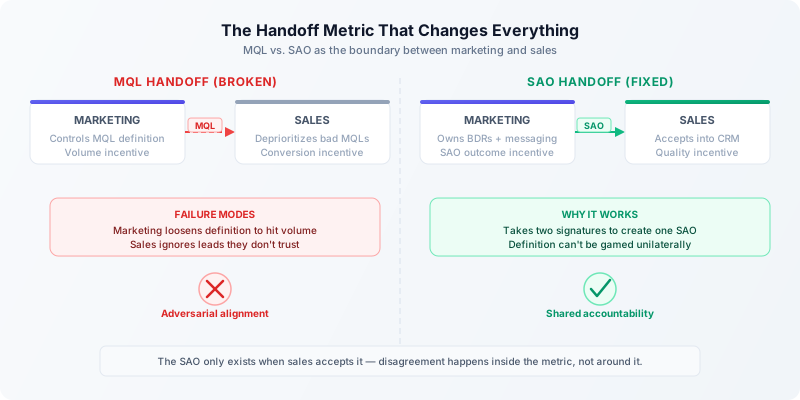
The MQL should never have been the handoff metric. It’s an internal marketing metric — a threshold marketing uses to decide when a lead is worth investing further to nurture. Turning it into the metric that crosses the boundary between marketing and sales is the original sin of modern B2B demand generation.
Once it sits at the handoff, two things happen. Marketing can be incentivized to loosen the definition when volume is running short — which is exactly what my CMO did. At the same time, sales is incentivized to deprioritize MQLs they don’t trust — which is exactly what any good sales team will do. Sales will not prioritize leads they don’t believe will convert. The misalignment is baked into the design.
The metric that should sit at the boundary is the Sales Accepted Opportunity. The distinction matters, because an SAO only exists when sales accepts it into the CRM system as an opportunity. The acceptance step is built into the metric itself. Marketing proposes, sales accepts. The disagreement about quality happens inside the metric rather than around it.
That single structural change — moving the handoff from MQL to SAO — removes the temptation for either function to game the number. You can’t loosen the definition of an SAO unilaterally, because it takes two signatures to create one.
Why the BDRs Have to Move
Once you accept that the SAO is the right handoff metric, the BDR reporting line becomes obvious. It just doesn’t become obvious in the direction I originally thought or wanted.
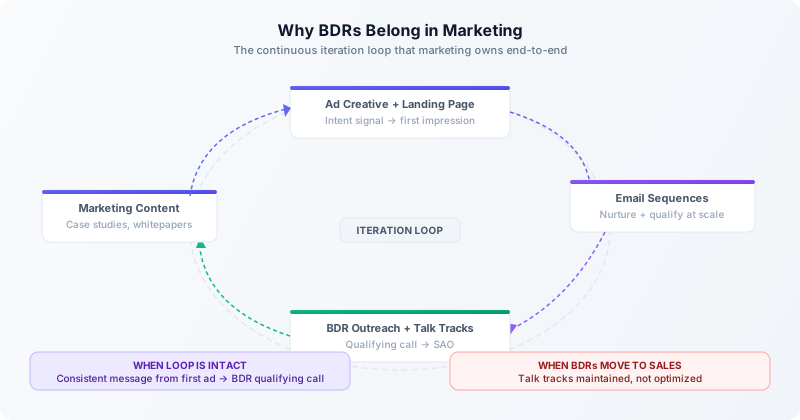
If marketing is accountable for producing SAOs — leads that sales will actually accept and prioritize — then marketing needs to own the entire process of turning an intent signal into a qualified conversation. That includes the landing pages, the ads, the email sequences, the marketing content, the BDR outreach, and the qualifying talk tracks that determine whether a prospect is ready to become an opportunity. All of it is the same iteration loop, and it is most effectively optimized when it reports under one function.
And here’s the part I didn’t fully appreciate when I was demanding the BDRs report into sales: iterating on messaging at scale is a marketing discipline. It’s what marketing teams do every day. Sales teams iterate on messaging as a side activity while they’re running deals, managing forecasts, and closing quarters. When BDR talk tracks sit inside sales, they get maintained rather than optimized. When they sit inside marketing, they become part of the same iteration loop as the landing pages, the ad creative, and the sequences that generated the lead in the first place.
The result is a continuous improvement process and message coherence. A prospect experiences a consistent thread from the first ad impression through the BDR qualifying call. That coherence is the actual mechanism that converts intent into opportunity. Split the loop across two functions and the optimization suffers.
What the CRO Actually Gets in Return
The argument I would have needed to hear back then, as the CRO fighting to keep the BDRs, is this: giving up the BDR function doesn’t mean giving up control over the number. It means trading one kind of control for another.
You stop controlling how leads get generated, and you start controlling whether they’re good enough to accept. That’s a much more powerful seat to sit in. Because now the question isn’t “is marketing sending me enough MQLs”. It shifts to “is marketing delivering the SAO volume and quality I need to hit my number, and if not, what specifically needs to change in their process to fix it.”
That’s a better conversation for a CRO to be having. It’s a conversation about outcomes rather than activity. And it’s a conversation that doesn’t put you on the opposite side of the table from the CMO, because you’re both now measured on the same thing.
The Honest Version of What I Was Really Solving For
Looking back, I wanted the BDRs under me because I didn’t fully trust that marketing could deliver the lead quality I needed in the timeline I needed it. That wasn’t a character judgment about my CMO. It was a structural problem. The function generating my leads was being measured on a metric that had nothing to do with whether those leads would actually convert, and I had no good way to hold them accountable for the gap.
The right answer wasn’t to pull the BDRs under sales. The right answer was to change the metric. Once the metric is the SAO, marketing is accountable for the outcome I actually cared about, and the BDR function is best positioned inside the team iterating on the messaging that gets there. I didn’t need to control the execution. I needed the system to make the execution accountable to the right outcome.
That’s not a distinction I could have made at the time. It’s one I spent years learning.
To the CROs Reading This
If you’re currently fighting to keep the BDR function under sales, or you’ve already won that fight and you’re quietly frustrated that it’s not delivering what you expected, I’d gently suggest the instinct driving that fight is probably the same one I had. You don’t trust that the current system will deliver the leads you need on the timeline you need them, to keep your credibility in the organization and ultimately your job.
It’s natural to feel that way. The CRO is the shortest-tenured role on the executive team. But the solution isn’t to absorb the function. It’s to change what the function is measured on.
Move the handoff metric to SAO. Move the BDRs to marketing. Keep the iteration loop intact. And spend your energy on the conversation that actually moves the number — whether the SAOs you’re being handed are good enough to close and your team is converting them into bookings.
That’s the CRO seat that actually drives growth. It’s also the seat I wish I’d been willing to sit in many years earlier than I was.
See Delivr.ai in action
Start a free Proof of Value and see how Delivr.ai turns your anonymous traffic into actionable pipeline.