
How Identity Resolution Impacts Attribution
Attribution without identity is guesswork. Learn how person-level identity resolution transforms measurement from a reporting function into an operational revenue advantage.
By Delivr.ai
Identity resolution
Keep reading
- ArticleWhat Is Identity Resolution?A deep dive into how identity resolution works: from deterministic matching and identity graphs to real-time visitor identification at scale.
- GuideDeterministic vs. Probabilistic Match Rates: The Honest NumbersMatch rate is the most abused number in visitor identification. What it really measures, why reported rates are inflated, and how to verify any vendor’s claim on your own traffic.
- GuideWebsite Visitor Identification: The Complete Guide (2026)How website visitor identification works: company-level vs. person-level, deterministic vs. probabilistic, and why match rates vary. A buyer’s guide to de-anonymizing your traffic.
- ResearchPsychological Reactions to Being Confronted About Anonymous Online BehaviorOriginal research on why people deny tracked behavior: defense mechanisms, psychological reactance, and what it means for identity resolution.
- GuideThe 2026 Identity Resolution Buyer’s GuideA 7-step framework for evaluating identity resolution vendors — matching methodology, data ownership, ID interoperability, real-time capability, and total cost of ownership.
- GuideRFI Questions for Identity Resolution VendorsThe essential checklist every buyer should use when evaluating identity resolution platforms: data onboarding, privacy, activation, and accuracy.
Attribution without identity is guesswork. You can run multi-touch models, time-decay models, algorithmic models — but if you can’t connect a website visit on Tuesday to a demo request on Thursday to a closed deal six weeks later, none of those models reflect reality. They’re distributing credit across anonymous touchpoints that may or may not belong to the same person.
Identity resolution is the layer that makes attribution trustworthy. It connects fragmented data points — cookies, device IDs, email addresses, CRM records, and behavioral signals — into a single, unified view of each individual. When every touchpoint resolves to a known person, attribution stops being a statistical exercise and starts being an operational advantage.
The Attribution Blind Spot
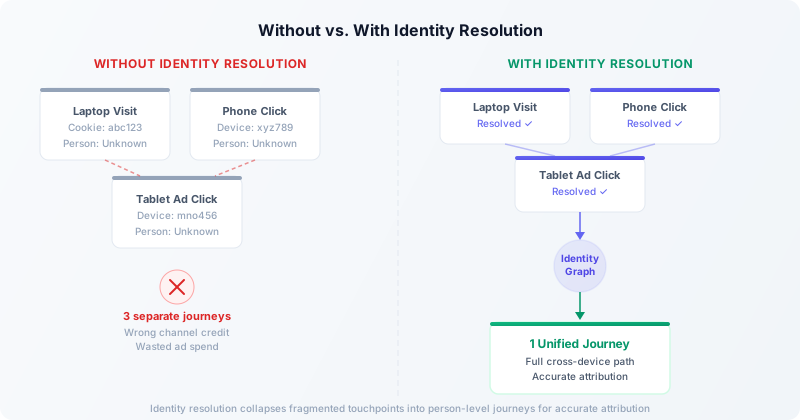
Most attribution systems inherit a fundamental flaw: they’re built on anonymous or semi-anonymous identifiers. A cookie tracks a browser, not a person. A device ID tracks a phone, not the executive carrying it. When the same buyer researches your solution on their laptop at work, reads a case study on their phone during lunch, and clicks a retargeting ad on their tablet that evening, traditional attribution sees three separate journeys.
The result: first-touch attribution credits the wrong channel. Last-touch attribution credits the wrong interaction. Multi-touch models distribute credit across what they think are different people. Your media spend decisions are based on a fragmented picture of a journey that, in reality, belongs to one person.
Identity resolution eliminates this blind spot by collapsing those three device-level journeys into a single person-level journey. Now attribution models can see the complete path — from anonymous first visit through every touchpoint to conversion.
First-Party Data: The Foundation
Effective attribution starts with a first-party data strategy. The data flowing through your CRM, marketing automation platform, website analytics, and sales engagement tools contains the raw material for person-level attribution — but only if you can connect it.
The challenge: this data is typically siloed. Your CRM knows who closed, your marketing platform knows who clicked, your analytics tool knows who visited, but no single system sees the complete picture. Data is also dynamic — people change roles, switch companies, use new devices. Static snapshots decay rapidly.
An identity graph solves both problems. It creates a persistent, privacy-compliant link between all the identifiers associated with a single person, updated continuously as new signals arrive. When a known contact visits your site from a new device, the identity graph recognizes them. When a prospect who’s been researching anonymously finally fills out a form, the graph retroactively connects their entire prior journey.
How Identity Resolution Transforms Attribution
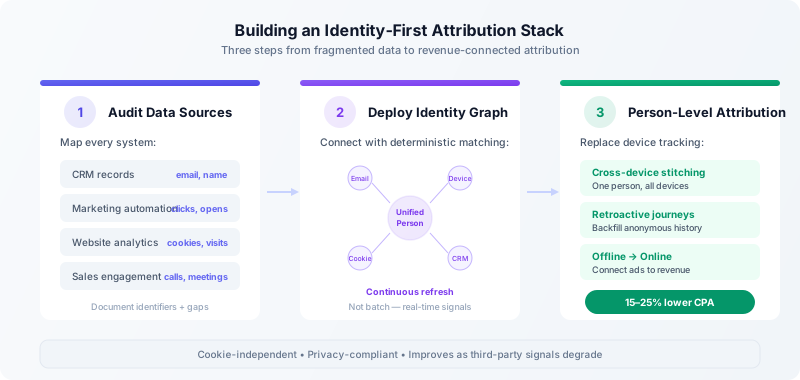
With identity resolution in place, attribution models gain three capabilities that were previously impossible. Cross-device journey stitching means the same person is tracked across phone, laptop, tablet, and CTV — eliminating the over-counting that inflates top-of-funnel metrics and obscures true conversion paths. Retroactive journey completion means that when a visitor is identified at any point, their entire prior anonymous history is attached to their profile, revealing which early-stage touchpoints actually influenced the buying decision. Offline-to-online connection means identity graphs that resolve to deterministic identifiers (like hashed emails) can connect digital engagement to CRM outcomes — linking ad impressions and content downloads to pipeline movement and closed revenue.
The impact is measurable. Organizations implementing identity-first attribution report 15–25% reduction in cost-per-conversion as spend shifts toward channels that actually drive outcomes. Match rates to website visitors increase by 4x or more, giving attribution models dramatically more data to work with. And because the identity graph operates independently of third-party cookies, these improvements are durable — they don’t degrade as browser restrictions tighten.
Building Your Identity-First Attribution Stack
Step one: evaluate your current identity infrastructure. Map every system that touches customer data and document the identifiers each system uses. Where are the gaps? Where do identifiers break across systems? This audit reveals the specific integration points where identity resolution will have the highest impact.
Step two: implement an identity graph that connects your existing data. The graph should support deterministic matching (hashed emails, authenticated logins) as the primary resolution method, with probabilistic signals as a secondary layer. Prioritize a graph that refreshes continuously rather than in batch — intent signals are perishable, and stale identity data produces stale attribution.
Step three: redesign your attribution model around person-level data. Replace device-level touchpoint tracking with person-level journey tracking. Extend your attribution window to capture the full B2B buying cycle (often 3–6 months). And build in offline conversion data so your model reflects the complete path from first anonymous visit through closed revenue.
The Privacy-Compliant Path
Identity-first attribution is also the privacy-first path forward. Deterministic resolution built on first-party data and consented publisher relationships eliminates dependence on third-party cookies — the identifier most under regulatory and browser pressure. By resolving to hashed emails through authenticated networks, identity graphs maintain precision while exceeding GDPR, CCPA, and IAB TCF compliance requirements.
This creates a compounding advantage: as cookie-based attribution degrades for competitors still relying on legacy infrastructure, identity-first organizations gain clearer signal and more accurate spend allocation with every passing quarter.
From Measurement to Revenue Engine
Attribution is often treated as a reporting function — something you check after a campaign ends. Identity resolution transforms it into an operational capability. When you know which touchpoints actually drive revenue for specific buyer personas, you can reallocate budget in real-time. When you see a high-value prospect’s complete cross-device journey, you can trigger sales outreach at exactly the right moment. When your CFO asks which channels justify next quarter’s investment, you have person-level evidence rather than platform-level estimates.
The organizations that win aren’t the ones with the most sophisticated attribution models. They’re the ones with the cleanest identity data feeding those models. Identity resolution is the infrastructure that makes every other measurement capability reliable.
See Delivr.ai in action
Start a free Proof of Value and see how Delivr.ai turns your anonymous traffic into actionable pipeline.